
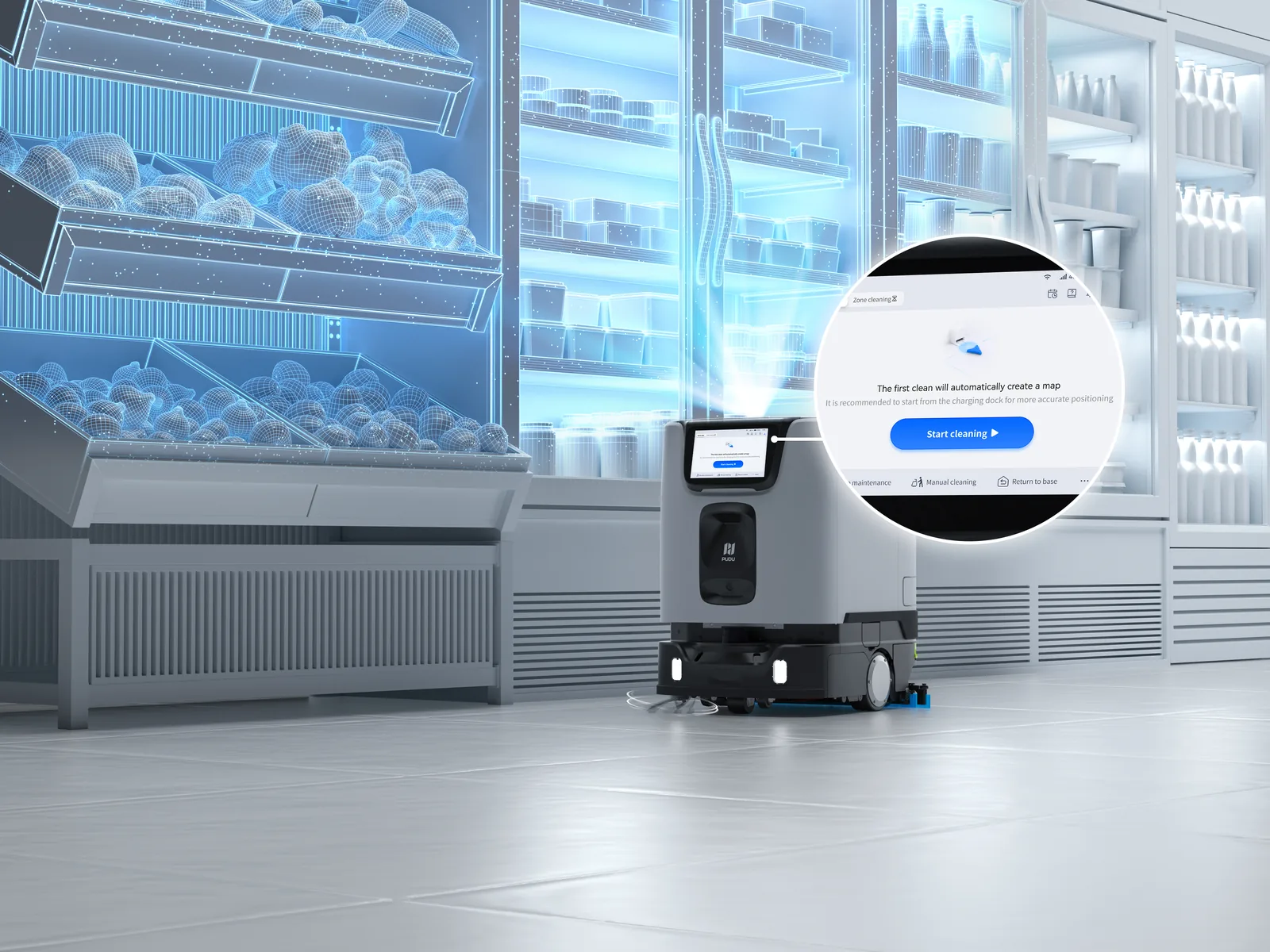
Commercial cleaning robots grew up in big buildings. The economics worked first in warehouses, airports and shopping centres, where a single machine could displace enough labour hours to pay for itself quickly, and where the floor was wide open enough that a large machine could actually drive on it. Everything about the category, the coverage figures quoted in m²/h, the physical size of the machines, the way they are sold, followed from that.
The result was a gap. The overwhelming majority of Australian businesses that clean a hard floor every day are not warehouses. They are small-format retail, hospitality, clinics, pharmacies and single-tenancy offices, and for a decade the answer they got was that automation started somewhere above them.
Why small sites were skipped
Three reasons, and only one of them was price.
The first was physical width. Until recently the smallest serious commercial machines needed around 70 cm of clear space to pass. That sounds narrow until you measure a convenience-store aisle between two chiller runs, or the gap between café tables at service. A machine that can only clean the open middle of a room leaves the operator doing all the awkward parts by hand, which is exactly the part that takes the time.
The second was what the machine did not do. Plenty of compact units scrub. Fewer sweep, vacuum and dust-mop as well, which means a small site still needs a separate sweep before the scrub, and the labour saving halves.
The third was the end of the shift. This is the one buyers underestimate. If someone still has to fill a clean-water tank, tip out dirty water and rinse a mop head at close, the cleaning labour has been moved rather than removed. On a large site that residual ten minutes is trivial against the hours saved. On a small site it can be most of the job.
What changed in 2026
Manufacturers moved down-market with machines designed around the small-site constraints rather than shrunk-down versions of large ones. The clearest example is the PUDU ET1, launched on 12 August 2026 and built explicitly for floors between 100 and 800 m². It passes through a 50 cm gap, runs scrubbing, sweeping, vacuuming and dust-mopping in a single pass, and docks to a station that charges it, refills clean water, drains wastewater, doses detergent, rinses the roller and squeegee, spin-dries the roller and heats the water for the next run.
The specification worth noticing there is not the coverage rate. It is that the list of end-of-shift jobs a person used to do is now a list of things the dock does. That is what makes automation viable at a scale where there is no cleaning team, only staff who would otherwise stay late.
The three specifications that actually decide fit
If you are assessing a compact unit for a small site, most of the datasheet is noise. Three numbers decide it.
1. Minimum passable width. Measure your tightest genuine route, not your widest aisle: between shelving, past the end of a counter, through the back-of-house door. If the machine needs more than that, it cannot do the part of the floor that actually gets dirty. This single number disqualifies more machines on small sites than any other.
2. What the dock automates. Ask specifically which of these the station does without a person: charging, clean-water refill, wastewater drainage, detergent dosing, brush or roller rinsing, drying. Every one it does not do is a task that lands back on your staff at close, and the honest way to compare two machines is to count those tasks rather than compare coverage figures.
3. Cleaning functions per pass. A machine that scrubs but does not sweep needs the floor swept first. On a small floor with real debris, that is a second cycle of the same room. Units that sweep and vacuum at the front and scrub and dry behind do it in one lap.
Coverage rate in m²/h matters far less at this scale than the industry's marketing suggests. On a 300 m² floor, the difference between 500 and 720 m²/h is about twelve minutes. The difference between reaching your aisles and not reaching them is the whole business case.
The break-even, honestly
Here is the arithmetic we run with small operators, using our own published figures rather than favourable ones.
A robot on subscription is from $50 a day, about $1,520 a month, which is roughly $18,250 a year including service, support, software and consumables. Commercial cleaning labour in WA typically runs $45 to $55 an hour, higher after hours and on weekends.
At $50 an hour, $18,250 buys about 365 hours of cleaning labour. That is the break-even: roughly one hour of floor cleaning a day, every day. Above that, the robot is cheaper than the hours it replaces and gets cheaper the more you run it, because the fee is flat. Below it, on labour alone, a robot does not pay for itself.
That is a genuinely useful line to know before anyone quotes you. A café mopping for twenty minutes after close is not a robot candidate on cost. A convenience store where a staff member spends an hour and a half a day on floors, or a medical centre paying a contractor to attend daily, generally is.
The reasons that are not labour cost
Some small sites buy anyway, and their reasons are usually sound.
Consistency. A machine cleans the same way at the end of a bad week as the start of a good one. In presentation-sensitive businesses that variance is the actual problem, not the cost.
Evidence. Robots log what they cleaned and when. For a franchisee reporting to a brand, a clinic with hygiene obligations, or anyone paying a contractor they cannot supervise, that record has independent value.
Staffing. Floor cleaning is a common reason small teams stay late, and late finishes are a common reason they leave. If you are struggling to hold staff, moving the worst task off the roster can be worth more than the hourly maths suggests.
Trading-hours presentation. A compact unit is quiet enough to run during trade, so the floor looks cleaned at 3pm rather than only at opening.
What to check before you commit
Measure the tightest route the machine has to take, in centimetres. Confirm your floor is a sealed hard surface, since these are scrubber-dryers rather than carpet machines. Work out honestly how many hours a week go on floors now, and where the dock will live, because it needs power and, ideally, drainage. Then ask the supplier which of the end-of-shift tasks their station does not automate, and listen carefully to the answer.
Ask, too, who services it. A compact robot with a two-week parts wait is a mop with extra steps. That is the part of the decision no specification sheet covers, and on a small site with no spare machine it matters more than any figure above.