
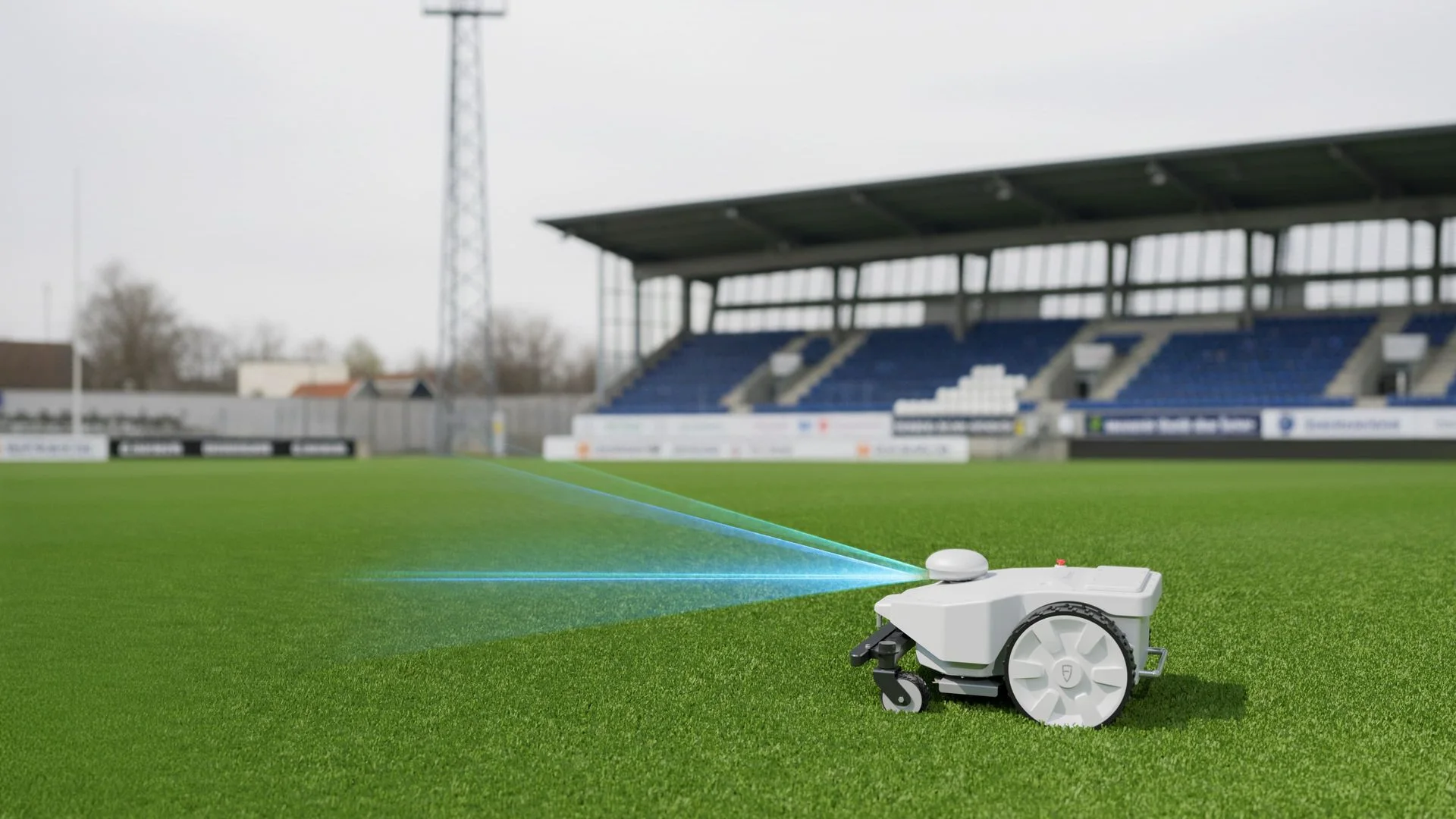
Anyone specifying a robotic mower for an Australian oval, reserve, campus or golf course ends up comparing the same two platforms: Husqvarna's CEORA and the FJD FRX. This is not a case of one serious machine and one pretender. Both are commercial-grade, both mow to virtual boundaries without a perimeter wire, and both have real deployments behind them. What separates them is how they cover ground, how they handle terrain, how you pay for them, and who supports them west of the Nullarbor.
Two credible platforms, one decision
Start with what Husqvarna gets right. The CEORA is the established large-area robotic mower in Australia, and Husqvarna is the only mowing OEM with a genuine WA dealer presence in this class. It also holds the strongest public proof point in Australian turf: Oatlands Golf Club replaced both of its fairway mowers with CEORAs, a deployment covered in detail by Australian Golf Digest. For a greens committee or a council that wants precedent before signing, that is a real one, and we do not pretend otherwise.
The FRX is the newer challenger with serious engineering behind it. FJ Dynamics was founded in 2017 by a former DJI chief scientist, is backed by Tencent, and reports more than 200,000 units sold across 140-plus countries, with RTK navigation inherited from its agricultural autosteer systems. The FRX is the mid-size commercial workhorse of its turf range. The comparison, then, is between two serious platforms built around different assumptions about what a site looks like.
Coverage: one large unit or several mid-size ones
Per unit, the numbers favour Husqvarna. The CEORA 546 EPOS is rated at a managed area of up to 50,000 m², with some configurations quoted to 75,000 m², the largest per-unit figure in the Australian market. The FRX cuts 8,000 m² per battery charge; in auto-docking trim one unit keeps about 20,000 m² cut every 24 hours, and in battery-swap trim, where site staff rotate its hot-swappable 1 kWh batteries, a single unit reaches 96,000 m² over 72 hours.
How those figures translate depends on the shape of the work. One very large contiguous area under one manager is CEORA territory: one machine, one dock, one map. But a robot cannot drive itself between suburbs, so a council with five ovals in five locations gets nothing from a 50,000 m² rating. That workload suits five mid-size units, each sized to its site and all coordinated through one fleet dashboard, which is exactly how the FRX is meant to be deployed.
Cutting, slopes and weather
The CEORA mows systematically under Husqvarna's EPOS satellite navigation, and the Oatlands deployment shows the result holds up on fairways. The FRX navigates by RTK GNSS fused with vision, with its RTK base station included in the box. Its cutting envelope is wide for the class: a 520 mm twin-disc deck adjustable from 10 to 100 mm, spanning presentation turf through to rough, and an OEM-rated 25° working slope that covers the banks, mounds and batters most large mowers avoid. It is sealed to IPX5, so Perth winter rain and an end-of-week washdown are both within spec. On flat, open, very large turf the two machines are closer than the spec sheets suggest; the FRX pulls ahead as sites get steeper, tighter or more scattered.
Commercial terms: one way to buy, or three
In WA the CEORA 546 EPOS kit is listed at $55,899 including GST by a Perth dealer. That is a capex purchase through a traditional dealership: you buy the machine, you own it, and support runs through the dealer. It is a clean, well-understood transaction, and for an organisation that prefers to own its plant it works.
The FRX is quoted per site rather than off a price list, and it comes with a choice of three structures: mowing as a service from $50 a day with the robot, mapping, blades, service and software included; lease over two to four years; or outright purchase with an optional Care Plan. The hardware sits at a fraction of the CEORA's price, but the more important difference for most buyers is that the cost can sit in the operating budget as a daily rate instead of arriving as a single capital line. As far as we can find, no one else in the Australian market offers a commercial mowing robot on subscription at all.
Service in WA: who actually turns up
Here Husqvarna earns its second genuine point: a CEORA buyer in Perth has a local dealer counter, local parts and a national brand behind the machine. That is worth something.
The FJD picture needs saying plainly. The established FJD dealers sit in Sydney, Melbourne and Brisbane; the largest lists shipping to NSW, Victoria, Queensland and the ACT only, with installation limited to its own metro area. Bought from the east coast, an FRX arrives in WA as a crate, with no one local to commission it, map the ovals, change blades or handle a warranty claim. That is the gap we close: Perth Robots surveys, deploys, maps and services FJD robots from Perth, with same-day metro response and next-business-day parts for regional WA. A robotic mower is an outdoor machine with consumable blades, and whoever supplies it needs to be reachable in your time zone.
When the CEORA is the right call
Choose the CEORA when the job is one very large contiguous area: a fairway programme across a whole course, or a single flat precinct where one machine rated to 50,000 m² or more beats coordinating several smaller units. It also makes sense if you already run a Husqvarna equipment fleet and value one dealer relationship across it, or if your procurement strongly favours owning plant through an established dealer channel. Those are real reasons, and when they apply to a site we survey, we say so.
When the FRX is the right call
Choose the FRX when the work is several mid-size areas rather than one giant: ovals, reserves, school grounds and golf surrounds and roughs that each sit comfortably inside 20,000 m² a day. Choose it when the budget prefers a daily operating cost to a capital purchase, when the site carries slope work up to 25°, or when WA-local service is a hard requirement rather than a preference. It leads our landscaping robot line because those conditions describe most WA council, school and club sites we see.
The comparison that matters is per site
Spec sheets do not settle this; the site does. Area, shape, slopes, tree cover, cutting frequency and how the budget is structured decide which platform wins, which is why we start with a free site check rather than a quote. We measure the ground, model both machines where the CEORA is a genuine contender, and put the per-site maths in front of you. If the numbers do not stack up for a robot at all, we will tell you. Contact us to book the site check.