A warehouse floor is never finished. Every inbound pallet sheds wrap, strapping and dust; every forklift lays down tyre marks and tracks debris from the yard; and every aisle has to stay clear and clean for the next pick, the next safety walk, the next customer audit. Across a 10,000 or 20,000 m² building, that is hours of floor work a day, repeated on every shift, in a labour market that is hard to staff and getting harder.
That repetitive, large-area floor work is exactly what an autonomous cleaning robot is built to take over. A sweeper or scrubber maps the building once, then runs a set route to the same standard every time, overnight, between shifts, or alongside the team, and logs every run, so there is a record of what was cleaned and when. For a site that gets audited, that audit trail is worth as much as the labour it frees up.
The floor that never stays clean
Warehouse floor cleaning is not a one-off job; it is a standing line on the roster. Dust settles continuously on racking, beams and floor; debris collects at pick faces and along travel lanes; and spills, shrink-wrap and broken pallets turn up wherever product moves. The work is repetitive and physical, it has to happen on time regardless of who is rostered, and it competes with picking and despatch for floor access during the day.
So it tends to get squeezed: done quickly between other tasks, or pushed to a night shift that is expensive to run and hard to fill. The cost of keeping a warehouse floor clean isn't really the scrubber or the broom; it is the recurring labour to push them across that much floor, shift after shift, and the slow drift in standards when the labour isn't there.
Cleaning around live forklift traffic
The thing that makes a warehouse different from an office or a shopping centre is the traffic. Forklifts, reach trucks, pallet jacks and people share the floor, often around the clock, and any cleaning method has to work without getting in their way or creating a hazard. This is the question every warehouse manager asks first, and it is a fair one.
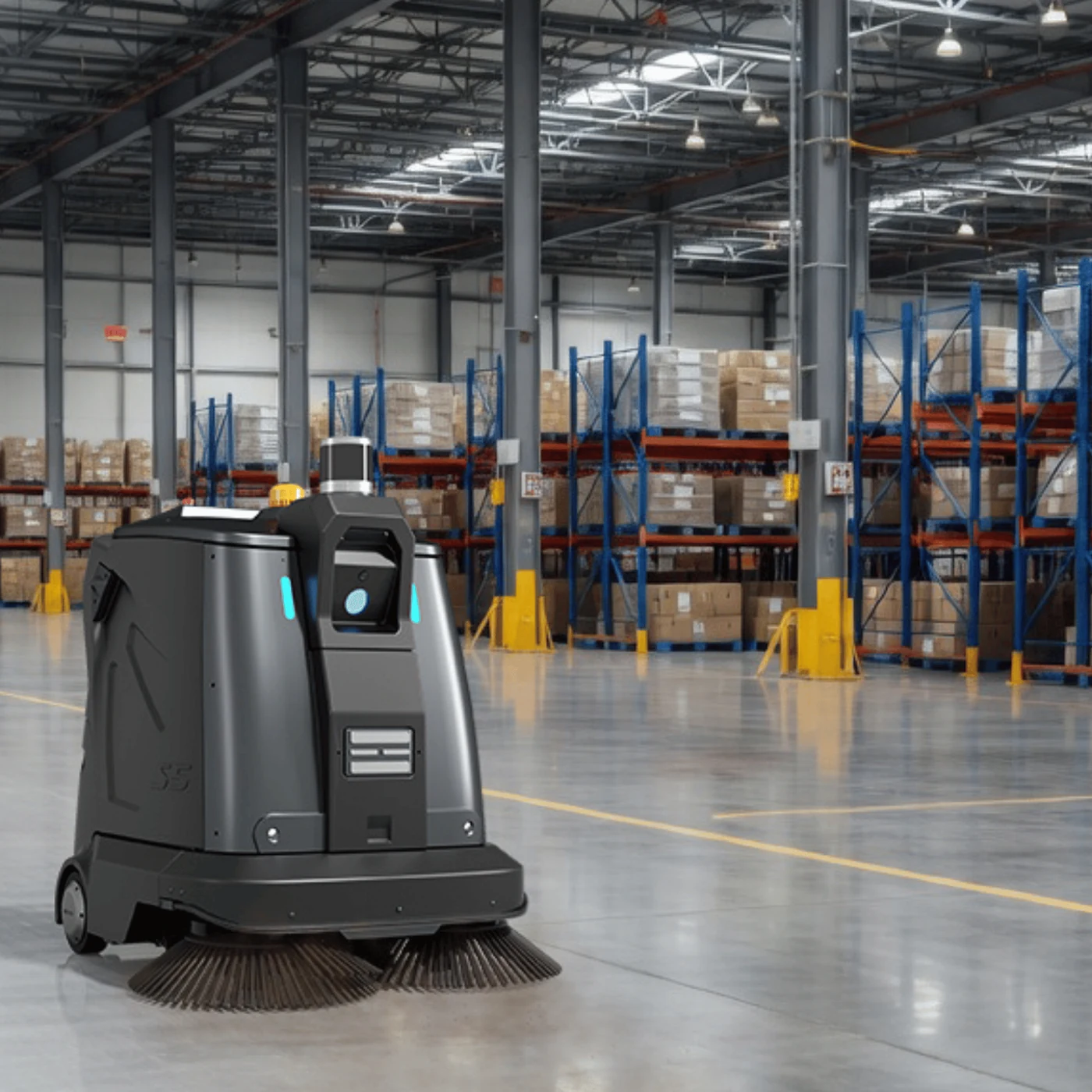
The autonomous sweepers run 360-degree LiDAR with vehicle and person detection, so they slow, stop or reroute around forklifts, pallets, people and spills rather than ploughing on. During commissioning the floor is mapped and no-go zones are set (loading docks, battery bays, live pick faces) so the robot keeps clear of the areas that are working and cleans the lanes and open floor that are not. It is rated for live commercial environments, which is the point: it earns its keep by cleaning while the building runs, not by waiting for it to stop.
Sweep, scrub, or both
A warehouse rarely needs one machine doing everything. The fleet is matched to the floor and the soiling, and the right answer is often a sweeper for the bulk dry work and a scrubber for the areas that need a wet clean.
Most large hard-floor warehouses start with the Cenobots S5 industrial sweeper. It clears dry debris and dust across open floor and wide aisles at around 2,500 m²/h, which is the work that eats the most labour. Sites that need a wet scrub on sealed concrete (food handling, beverage, anywhere with residue rather than just dust) add the Cenobots L50 scrubber-dryer, which washes and dries in a single pass at about 2,200 m²/h so the floor is back in service straight away. Dusty or waterless environments, where you don't want to introduce moisture at all, use the Perth Robots SW80 heavy sweeper-vacuum.
The reason to carry several lines is that the building gets the unit that fits it, rather than whatever a single-brand reseller happens to sell. A high-throughput DC with sealed concrete and a food-grade area is a different problem from a dusty hardstand-fed transit shed, and the matching is what gets confirmed at a site survey.
Dust you can't afford to spread
In a lot of WA warehouses the dust is the whole problem: iron-ore fines tracked in from the yard, flour and sugar in food facilities, fine particulate in pharma and cold storage. A sweeper that just stirs that dust back into the air is worse than useless; it turns a floor problem into an air-quality and compliance problem.
The sweepers run HEPA-grade filtration to hold fine dust rather than redistribute it, which is exactly what matters in food, pharmaceutical and cold-storage settings where airborne particulate is audited. On dusty sites the brush-and-filter schedule matters as much as the machine, so the right filtration spec and service interval are set for the building at survey rather than assumed.
What it costs to run
The honest comparison for a warehouse isn't robot versus broom; it is the robot against the fully-loaded cost of the labour currently pushing a machine across that floor: wages, on-costs, supervision and the night-shift premium, on a line that is hard to fill at all. If you want to put numbers on it for your own site, the cost calculator estimates the annual saving and the hours freed from the floor area and your current cleaning hours.
How you pay for it is a separate decision. A warehouse deployment can be structured three ways: robot-as-a-service as a flat monthly subscription with service, support and software included; lease-to-own over a two-to-four-year term; or an outright purchase with an optional Care Plan. You can subscribe or own from as little as $50 a day. For a 3PL or a tenant on a lease shorter than the asset life, the subscription tends to fit, because there is no capital sunk into a building you may not hold in five years; for an owner-occupier running the same floors for a decade, owning can be the cheaper path. The right structure depends on the site and the tenure, which is what the survey works out.
Why local service matters, even in the metro
A cleaning robot is only as good as the support behind it. A unit that's down for a week takes its floor straight back to manual labour and sours the whole case. Service from within WA (deployment, mapping, parts and response handled locally, with remote diagnostics from Perth) is what keeps a robot actually running, whether the building is in Kewdale, Canning Vale, Henderson or Hazelmere. It matters even more for distribution networks that run a regional leg into the Pilbara or the Goldfields, where an east-coast supplier can't economically reach the site at all. The WA-local service position is the part of the proposition a national newcomer can't easily copy, for the same reason it suits remote mining-camp floors.
Autonomous cleaning won't empty a warehouse of people, and it isn't meant to. It takes the most repetitive, hardest-to-staff part of the job (pushing a machine across the open floor) off the roster and turns it into a managed, logged, predictable line, so the team can be put where a person is actually needed.