Every swing, hundreds of rooms turn over. Mess halls feed the whole camp three or four times a day and the floors wear it. Ablution blocks, wet areas, corridors and recreation rooms all need cleaning to a standard, every day, in some of the most remote and hardest-to-staff places in the country. The cleaning never finishes. It just comes around again with the next bus from the airport.
That recurring floor work is exactly what an autonomous cleaning robot is built to take over. And because the WA resources sector runs the largest concentration of remote accommodation in the country, it's the clearest case in Australia for putting robots on the floor.
The cleaning that never stops
Floor cleaning in a camp isn't a one-off job; it's a standing labour line. Rooms cycle on changeover, mess-hall floors get cleaned between every sitting, and common areas need a consistent result regardless of who's rostered on. The work is repetitive, physical and unglamorous, and it has to happen on time whether or not the right people turned up.
In remote WA that last part is the hard bit. Cleaning labour in the Pilbara and the Goldfields competes with every other site for a limited pool, carries FIFO accommodation and travel costs on top of wages, and turns over. When a cleaner doesn't make the flight, the floors still have to be done. The cost of a camp's floor cleaning isn't really the mop. It's recruiting, flying in, housing and retaining people to push it, shift after shift.
What an autonomous robot actually changes
An autonomous scrubber or sweeper does the repetitive, large-area floor work on its own. It maps the site once, then runs a set route to the same standard every time (overnight, between mess sittings, or alongside staff) and logs every run, so there's a record of what was cleaned and when. For an FM contractor accountable for a cleaning outcome, that audit trail is as useful as the labour it frees up.
It does not replace the cleaning crew. It takes the floor grind off them so they can do the work a machine can't: rooms, bathrooms, touchpoints, restocking and anything that needs a person. The robot covers the open floor; the crew covers everything else. On a camp that runs around the clock, that division is the point.
The robot has to suit a camp, not an office
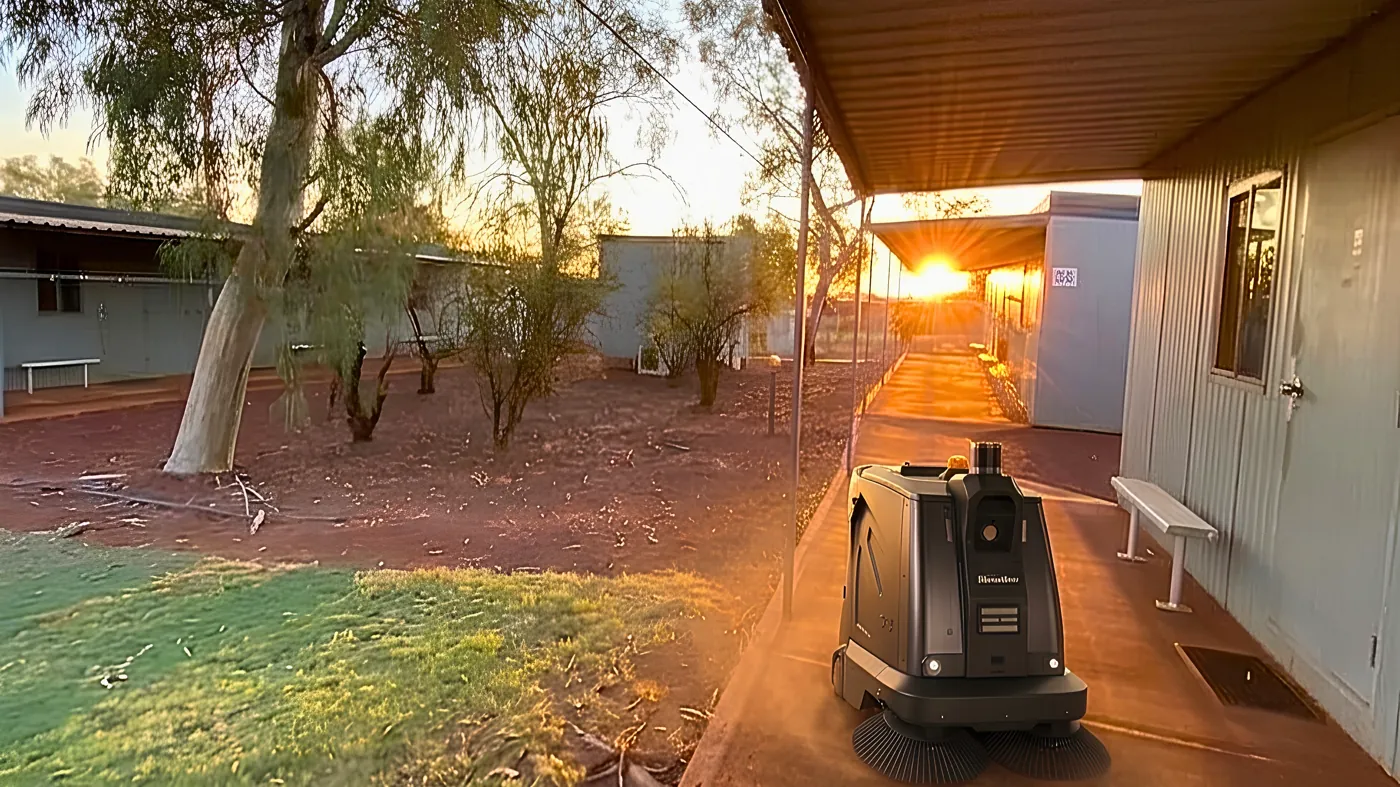
A camp is not a shopping centre, and the unit has to match it. The constraint that matters most in remote accommodation is plumbing: you can't assume a fill-and-drain point in every donga corridor or ablution block. The compact Cenobots L3 is built for exactly this. It pairs with a workstation and a mobile water tank for plumbing-free deployment, cleans at up to 2,016 m²/h on a 400 mm path, and has smart carpet detection for mixed room-and-corridor floors. That makes it suited to donga corridors, recreation rooms and back-of-house runs where there's no fixed water point.
Mess halls and larger common areas call for a bigger scrubber; hardstand, walkways and yards between buildings call for an outdoor sweeper. The Perth Robots XG covers up to 4,000 m²/h across outdoor areas, and is built for the dust and temperature swings of a Pilbara site. Dusty environments are the norm on a resources site, not the exception, which is why the right unit and a sensible brush-and-filter schedule get confirmed at survey rather than assumed. The point of carrying multiple robot lines is that the camp gets the unit that fits it, not the only one a single-brand reseller happens to sell.
Who actually buys this
The buyer here isn't the mining company. It's the FM contractor that holds the cleaning contract. Sodexo, Compass Group and ESS, Civeo, Morris Corporation, Aramark and the other remote-services firms sign for camp cleaning; the resource company specifies the outcome. So the conversation about autonomous cleaning belongs with the contractor's operations and procurement teams, the people accountable for delivering a clean camp on a fixed budget with a workforce that's hard to hold.
For those buyers, the commercial model matters as much as the robot. Capital sunk into a remote site is hard to redeploy if the contract moves; a monthly subscription isn't. That's why robot-as-a-service tends to fit camp deployments: the cost sits in opex alongside the contract, with service and support included, and there's no balance-sheet exposure if the work changes hands.
Robot trials are already happening in WA mining accommodation. Sodexo has run autonomous-robot trials at the Gudai-Darri operation, in delivery rather than cleaning. The direction of travel is clear, and floor cleaning is the next obvious use case: it's repetitive, measurable and labour-hungry, which is precisely where autonomy pays.
Why it has to be serviced from WA
Autonomous cleaning is only as good as the support behind it, and that is where most of the market falls down for remote WA. An east-coast supplier cannot economically reach Karratha, Port Hedland, Newman or Tom Price for a same-day fix; freight and technician time make it uneconomic before the SLA is even discussed. A robot that's down on a camp for a week is worse than no robot. Service from within WA, with deployment, parts and response handled locally and remote diagnostics from Perth, is what keeps an autonomous unit actually running on a regional site. For a contractor, that reliability is the whole proposition.
Three ways to run it
A camp deployment can be structured to suit the contract: robot-as-a-service (a monthly subscription with service, support and software included), lease over a two-to-four-year term, or an outright purchase with an optional Care Plan. You can subscribe or own from as little as $40 a day; the right structure depends on the site and the contract length, which is what a site survey is for.
Autonomous cleaning won't empty a camp of people, and it isn't meant to. It takes the most repetitive, hardest-to-staff part of the job (the floors) and turns it into a managed, logged, predictable line, so the crew and the contractor can put scarce remote labour where it actually counts.